
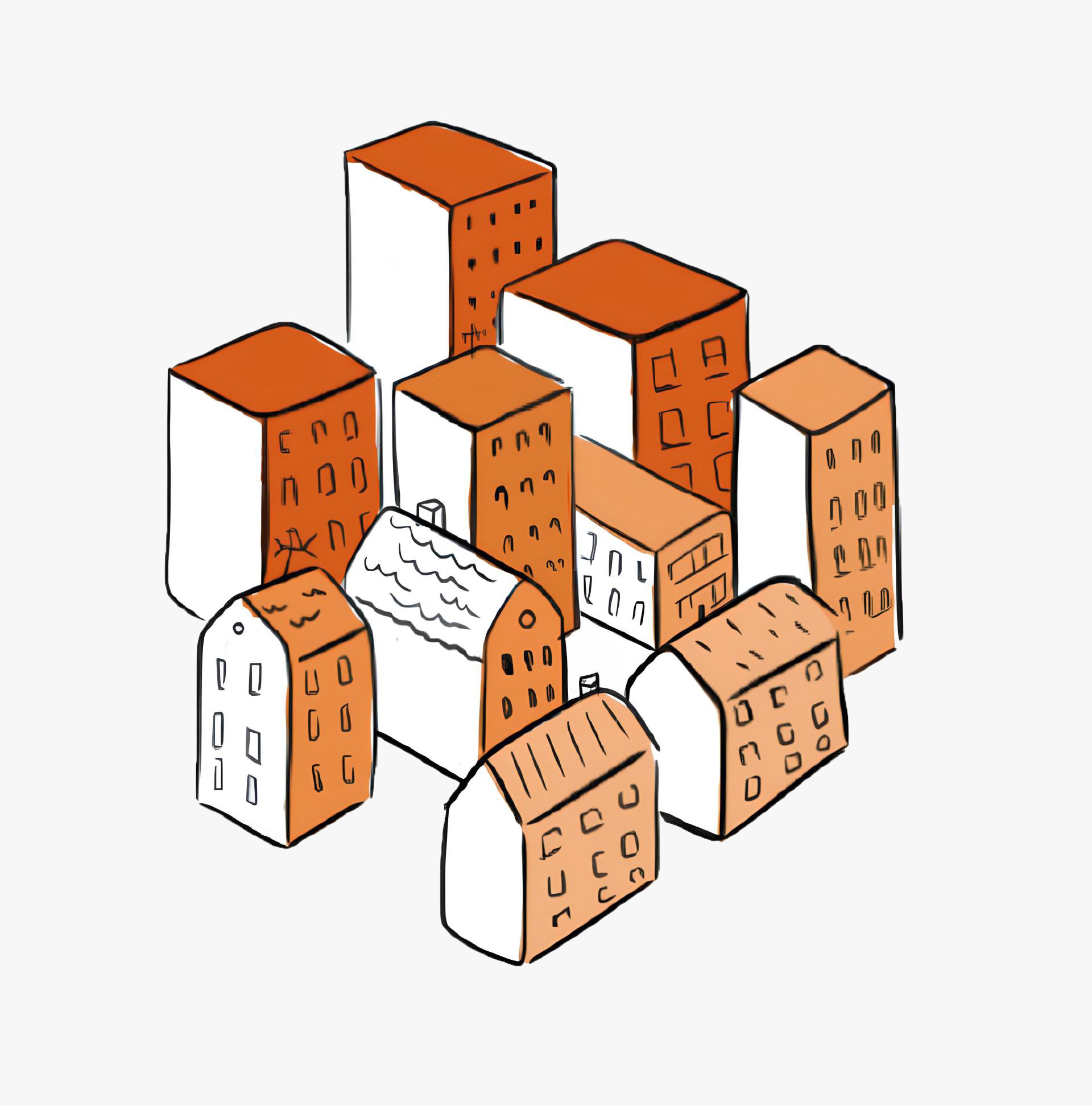
Residents of the compact city enjoy a highly efficient urban form characterized by close proximity to services, reduced travel times, and variety of uses and functions. A highly walkable environment that is supported by the urban layout encourages walking and cycling, providing opportunities for people to interact and businesses to emerge. An efficient public transport system provides affordable and better accessibility for all, bringing multiple economic and environmental benefits. Achieving a compact city implies creating an efficient urban space that is safe, comfortable and attractive for all its residents.
The Compact City relates to the New Urban Agenda transformative commitments: 34, 36, 37, 39, 43, 62, 67, 68, 69, 70

Ensure close proximity of urban services within the neighborhood that makes distances walkable, naturally creating a walking and cycling-friendly environment. Residents of the compact neighborhood should have 5 min walking distance (from 400 to 450 m) to key services. In some cases walking distance may be increased to 10/15 minutes depending on the city scale and a grid.

While planning urban services, it is important to analyse the surrounding context beyond the project area to ensure accessibility to maximum residents. Some urban services may maximize the impact of each other once located in close proximity (for example, a library will benefit from the proximity to a university or school).
1.1.1 Infrastructure for safety
To ensure better walkability, the urban environment should provide infrastructure for safe and convenient walking and cycling such as pedestrian sidewalks and cycling paths of appropriate size (physically separated were applicable, or with slow zones), street lighting, universally accessible pedestrian infrastructure, elements for passive surveillance such as street retail, etc.

1.1.2 Permeability of Urban Fabric
The permeability of the urban fabric can significantly contribute to the efficiency of movement and perception of compactness by creating a connected and continuous network of open spaces that prevents from overcrowding. It is important to consider fine-grained urban pattern and appropriate scale of blocks and buildings that increase options for pedestrian routes, promoting better use of functions and creating a walkable public space network within the urban layout.

1.1.3 Accessible Open Public Space
Public space plays a critical role in perceiving density and should be well distributed within the neighborhood to form a network. Pedestrians should be able to reach from their houses a public space or facility within a five-minute walking distance (the equivalent of 400-meter distance), as it is considered the most practical and realistic threshold. UN-Habitat’s Global Public Space Programme recommends evaluating the quality of a public space, as well as its walkable radius, as the catchment area identifies daily users and their movement flow. In some contexts, public spaces should be adjacent to residential units and/or social facilities.

1.1.4 Green Space Distribution
Urban green spaces play a vital role for the health and well-being of the residents of the compact neighborhood. Urban green spaces facilitate the reduction of the heat island, are necessary for storm water management, enhance biodiversity, and reduce noise and air pollution. It is important that green spaces are distributed in a way to serve more people, and part of a larger system of continuity. Although there are sometimes tradeoffs between density and green coverage, balances can be achieved.

Mixed land use, associated with contextually appropriate high residential density, and based on efficient public transport, is one of the core elements of compactness. The suggested floor area distribution for a mixed-use sustainable neighborhood is 40 to 60 per cent for economic use, 30 to 50 per cent for residential use and 10 per cent for public services. The recommended standards offers a range to allow for flexibility so that different contexts can adapt them to their own situations.

In some contexts, mixed-use environment is an integrative element of urban development (characterized by the first floor with small shops, activities). While planning a new development, it is important to analyse the character of local mixed-use development (the type of shops, street terraces, etc.) and leverage from the local good practices.
1.2.1 Compatibility of Uses
Mixed-use development should ensure mutual compatibility of uses (in a way they benefit each other and the surrounding areas) and their smart distribution to maintain a comfortable environment for residents. Sensitivity issues, noise and pollution levels should be considered as well as a system of designed access points to the neighborhood to maintain privacy and safety needs. Spatial buffers might be used to minimize conflicting uses within the neighborhood (greenery, courtyards, etc.).
In some contexts, the balance between private and public development should be maintained. Necessary privacy may be achieved with green buffers, vegetation, design elements and public space. The compatibility of building heights and proportions of street enclosure may be taken into account to emphasize certain functions (e.g. wider boulevards with higher development are appropriate for commercial functions, bystreet and human-scale environment may create a pleasant environment for child-friendly spaces, local stores, etc.).
1.2.2 Vertical Zoning
To ensure mixed-use environment and prevent monofunctional pockets of urban development, vertical zoning should be applied to block and building design. Lower levels of the building should be reserved for commercial uses or public services (libraries, shops etc.), and appropriate separation of incompatible uses should be considered. Vertical zoning may consider green roofing for recreational and agricultural purposes (where applicable).
An efficient public transport system is an essential element of compactness. Residents should have an easy and universal access within 500m walking distance to low capacity public transport (and 1000m to high capacity public transport) considering catchment areas for different transportation modes. Public transport stops should be designed according to the contextual needs (provide shade, sitting areas, waterpoints, etc.) and comply with universal design standards.

1.3.1 Active Streets
To ensure a safe and attractive environment that promotes walkability as a key element for a compact neighborhood, spaces adjacent to the streets should have diverse uses. Active street edges and building frontages create a pedestrian and cycling-friendly environment by providing better safety, places to stop. This implies that “complete street” design and compliance with universal accessibility standards are necessary.
While designing active street frontages, pedestrian passages should be reserved to maintain the physical and visual permeability of the urban fabric, which, in some contexts, may help to maintain local character.

1.3.2 Sustainable Parking Policies and Reforms
While ensuring appropriate space for surface parking, it is important to avoid vast expanse of parking surfaces or parking units with little contribution to the quality of the street. Where applicable and possible, consider permeable or semi-permeable paving and incorporate porous surface design. Parking design in this way will improve water quality, increase groundwater supply, and reduce urban heat island effects. Introduce more efficient management, adequate pricing, and reduction of on-and off-street parking to help de-incentivize driving, mitigate emissions, and reclaim valuable public space.
Cities should re-assess outmoded parking policies and implement parking reforms to protect the environment and improve quality- of-life for all residents. In addition, cities can explore opportunities to adapt the streetscape to facilitate diverse functions, activities and uses. Flexible streets and parking lots can be closed for vehicles at times and used for rush hour drop off, vending during off peak hours, or to host such community uses as markets, exhibitions or sport events. The design of loading and unloading zones through signage and patterned or painted surfaces, as well as through regulatory measures must be taken into account.

If the provision of surface parking lots in public spaces is mandatory due to urban regulations, surface parking may be used as transitional solution, that can be easily converted to other uses (e.g., public space, etc.). De-paved surfaces or permeable surfaces may be promoted to maintain and protect the existing eco-system that can be integrated in future uses.
The effective use of urban land should be achieved by increasing the density of development and activity. It is important to ensure that the high-density benchmark is locally relevant by assessing the overall efficiency and character of the urban form. To promote a high population density, an indicator around 150 p/ha for a sustainable neighborhood, which refers to an existing urban fabric and new green-field development, may be considered as a reference; however, density indicators may vary and should be carefully assessed depending on the context.
Achieving a balanced density is recommended, and involves the assessment and consideration of undeveloped/unused urban land, low- density pockets within the urban footprint for redevelopment or/and regeneration. Redevelopment can happen through modification of building units, increase of building height where applicable, etc. In some contexts, unused former industrial sites may provide potential for redevelopment/infill development.
1.4.1 Human Scale Environment
In compact development, human-scale factors should be given greater emphasis from the viewpoint of achieving a better quality of life. A human-scale environment facilitates communication among residents and interactions with the space. In addition, a people-centred approach, that is based on how a place is perceived and experienced, should be considered in the design in addition to particular recommendations on building heights.

Often, examples of human-scale development that support compact urban form and efficient density can be found in central/historic areas of the city. In some contexts, vernacular urban pattern performs better in terms of urban efficiency, vibrancy and density and may become a good inspiring practice for the new development. The visual, functional and design quality of the human landscape is imperative in compact and dense urban fabrics, especially to create ‘approachable spaces’ and to mitigate the impact of large scale projects.
Existing natural areas, vegetation and water should be preserved and integrated within the neighborhood, building better resilience through nature-based solutions, and creating pleasant recreational areas that improve quality of life within the compact neighborhood. In some contexts, agricultural uses may be protected and enhanced to improve the ecological situation, limit urban expansion, diversify the local economy and provide food security.

During the site analysis and assessment of planning pre-conditions, it is important to emphasize and map the natural assets to integrate in the plan. Vegetated areas, forests can be transformed into parks and public spaces. E.g. seasonal rivers may be part of the green boulevards or linear parks.
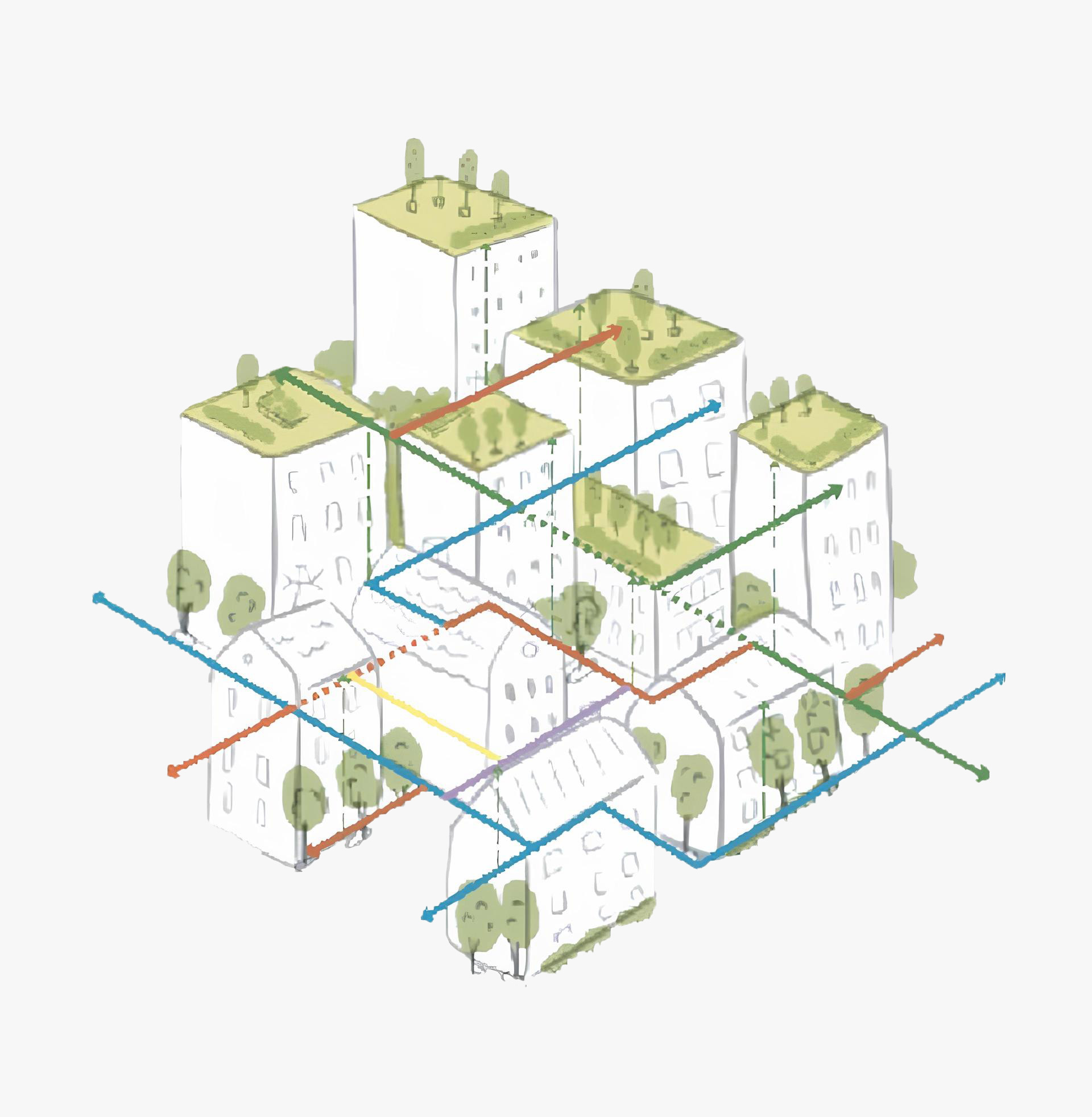
Residents of the connected city leverage from permeable and efficient street network with walkable and cyclable distances to close destinations while having access to multi- modal transport systems to connect with the opportunities of the wider city.
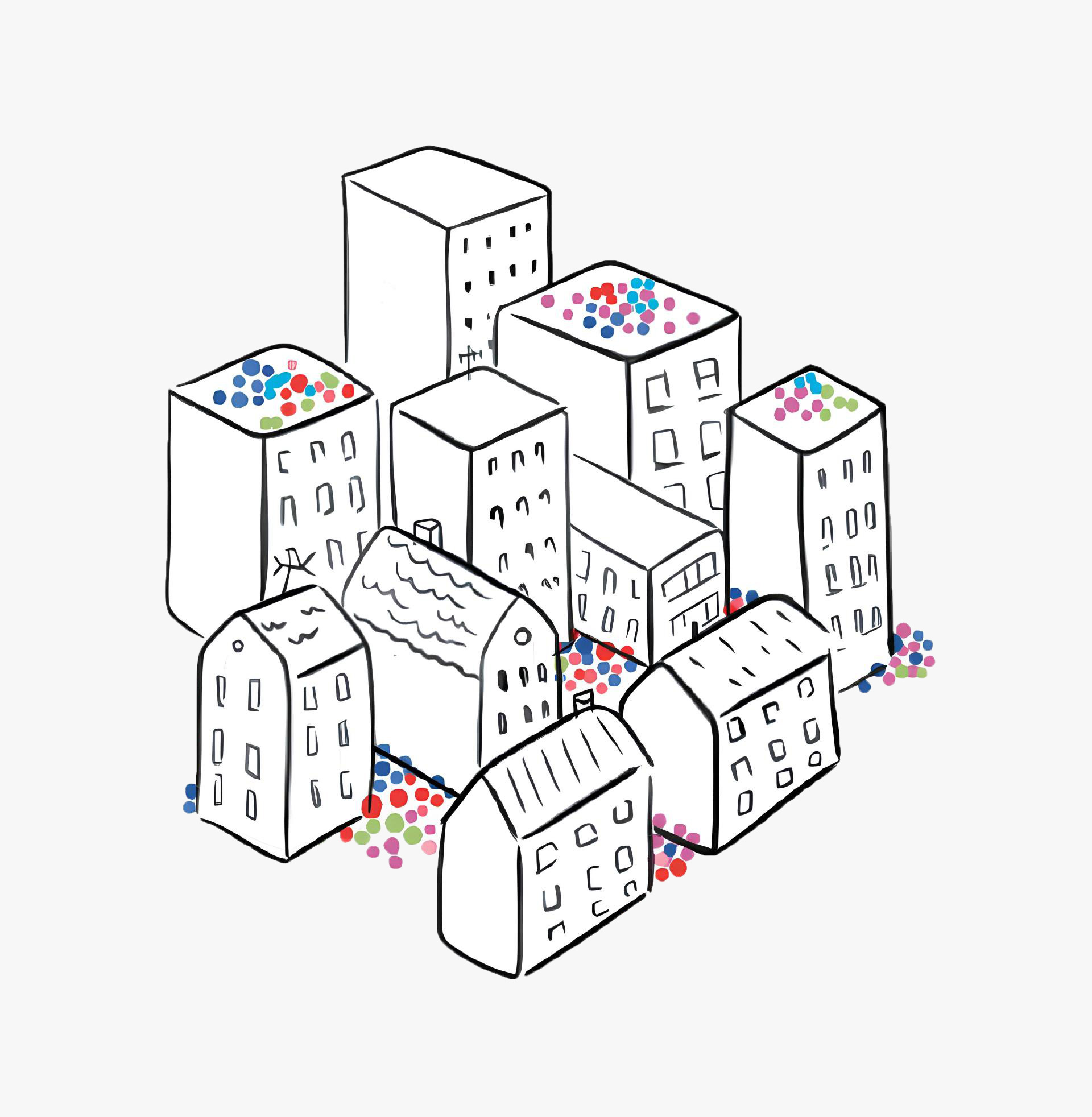
The residents of an inclusive city have equitable right to the city, access to services, employment, open public space, public transportation, and other opportunities the city provides.

Residents of the vibrant city have access to the diversity of activities, urban services, and economic opportunities.

All the residents of the resilient city are guarded against immediate and chronic stresses within urban systems and are prepared for future potential challenges.